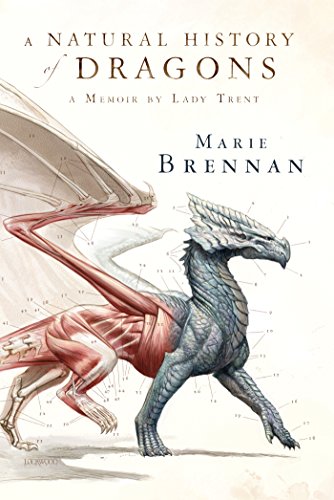
A Natural History of Dragons
Finally got around to finishing this novel and I’m very happy that I did. I’ve talked before about how the memoir format and complex sentence structure were both huge strengths of the story. Here, I wanted to focus on how these two elements work together.
(Minor spoiler) had brought with him half a dozen men: the sort of odds that may be entirely manageable in a drunk man’s boast, but which are rather more difficult in real life, especially when the half dozen have guns, and the two gentlemen and two women those guns are pointed at do not.
The descriptor of “odds that may be entirely manageable in a drunk man’s boast” is both funny, but also the kind of specific detail that speaks to the personality of the narrator. I also love how all of this detail is crammed into one sentence, because it gives the impression that the narrator is able understand at a glance the odds she’s facing. If it had been separated into separate sentences, it would have instead felt like she was taking longer to get a grasp of her situation—something that could have worked in a different situation, but would have hurt the suspense of this particular moment.

Circe
This one has been on my “To Read” list for a while and it’s been a treat going through it. I’m probably going to save most of my thoughts for a longer piece in the future, but for now I want to take a look at some great bits of writing from the book. It’s also a great contrast to our previous examples of Natural History of Dragons and A Gentleman in Moscow because the prose here is often simple in structure. However, that simplicity is impressive because of how much it says in only a few words.
Those were their earliest attempts at barbs, still dull, but day by day they sharpened.
What the sentence is getting across is the fact that the narrator’s verbal abuse starts small but becomes more painful over time. So starting with “still dull” and then going to “day by day they sharpened” gives the impression of time passing and lets the reader come up with a good idea of what those later barbs would be like. It shows how the sentences in the book are able to convey multiple things at once with just one bit of imagery.
Since a lot of the cast consists of Greek gods, the imagery needs to be more specific. This can be seen in how the narration describes Perses’ ability to recover instantly after giving birth.
All out kind recover quickly, but she was faster still, one of the daughters of Oceanos, who shoot their babies like roe.
What I really love about this image is that it not only conveys the idea that many of the characters in this book are more like forces of nature with human issues than actual humans, but it also uses an image specific to sea life—fitting given the subject is an ocean diety.
Though my favorite example comes from a scene where Circe decides to try this pain thing that her titan family seems both terrified of and fascinated by.
My skin leapt apart at the blade’s touch, and the pain darted silver and hot as a lightning strike.
The use of “leapt” is so damn great because it makes the wound feel fast and alive to the wound, like her skin is a creature dodging an attack. Words like “opened” or “cut” would have lacked that sense of immediacy or would have felt sterile in comparison. It also emphasizes that the cut is fast while the pain from it lingers, as demonstrated by the extra detail in the second half. Again, it’s incredibly simple but the sentence accomplishes everything it needs to beautifully.
What else?
Big thing I’ve been enjoying besides Circe is rediscovering my love of Young Justice. It’s probably gonna be something I come back to in a longer essay, but for now I’ll just say it’s a different but fantastic take on the DC Universe. It stays true to the huge scale and long history of the comics, but has stories that focus more on espionage than huge battles. It’s also got a great cast, tight plotting, and moments that rival Gargoyles and Batman: The Animated Series in terms of “how the hell did they manage to put this on a kid’s show?”
 The7thDraconian's Hoard of Stories
[…] 7/6-7/12 Dragons and Greek Sorceresses […]
LikeLike