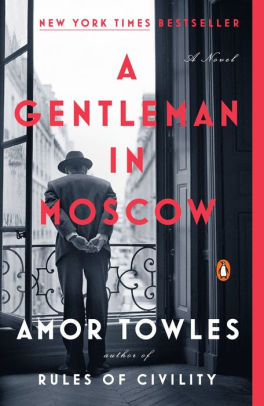
Didn’t get as much reading done as I would’ve liked, but the book I did spend time with this week was a good one: A Gentleman in Moscow by Amor Towles. Doing an analysis of the sentences in this book is both a treat and a challenge, because this book is so damn well written. If the prose in this book was a painting, it’d be in a museum somewhere—it is that impressive. So much so that one of the excerpts I’m analyzing is more than one sentece. The excerpt starts with the Count saying:
“And where is it exactly?”
…
(Nina) “At this moment, the card room.”
“Ah. So you play at cards?”
“Not really…”
“The why on earth are you going there?”
…
“Oh come on now,” the Count protested.
As someone who struggles with finding good ways to make pauses feel natural in his prose, I’m so impressed with how simple of a solution Towles uses that I get mad. Simply using ellipses in a line conveys the idea that silence has fallen, much more so than my usual method of saying, “Silence fell.” They make your eye pause for just a moment, an effect seen in Nina’s “Not really…” There, they make it clear Nina trails off. Using them on their own makes it feel like both parties are at a loss for words. It’s the kind of thing that seems so simple that I feel like a moron for not thinking of it.
Another thing that often trips me up in my own writing are transitions—whether I’m going from one scene to another or just implying that time has passed. Well, here’s Towles showing his wealth of experience and skill by making the whole thing look piss easy.
In the minutes that followed, a waiter was signaled, a samovar was ordered, and with thunderclouds accumulating over Theatre Square, remarks were exchanged on the bittersweet likelihood of rain.
What really impresses me about this sentence is the rhythm of it. It manages to go over the characters ordering their food and having a short ice breaker before getting into the story-relevant conversation, but it doesn’t feel like the author is skipping to the important parts. The events that only take a moment are told in few words while moments like the conversation about the weather—as well as the clouds that sparked that conversation—contain more words. This careful sentence structure allows the author to give enough information to make it clear time has passed while making that transition feel smooth as butter.
Finally I want to talk about the way this particular sentence uses em dashes, because this series is just as much about helping me steal ideas from better authors as it is giving you all insight into the skill said authors. Em dashes, something I had todo research into for this essay, are the kind of tool that can really open up new possibilities to writers. Have a sentence that you think needs just a bit more detail but feel like brackets or a colon doesn’t work? Then use an em dash to connect them. It feels less formal to readers than a colon and doesn’t disrupt the flow of your sentence like brackets would. Look at how it’s used here:
But once the tea was poured and the tea cakes were on the table, Nina adopted a more serious expression—intimating the time had come to speak of the weightier concerns.
A comma after “expression” might have worked, but not allow the next clause to have as much of an impact. Meanwhile, brackets would have thrown off the sentence’s rhythm. TIt could have just ended with “a more serious expression,” but that risks hurting the atmosphere of the scene by not making it clear what Nina’s “serious expression” is supposed to mean. Using an em dash to give more detail to the sentence allows Towles to make sure Nina’s expression is perfectly understood. It’s the kind of balancing act that I’m sure is only possible through a bunch of rewrites and drafts, but the work has paid off in spades.
What Else?
Considering I tend to consume more than just books, I thought this new section would be a good way to rave about other things that I’ve been enjoying over the week. So, this week I’ve been rereading Fullmetal Alchemist by Hiromu Arakawa and its has reminded me of why it’s my favorite manga of all time. The art is fantastic, the characters are a complete joy to come back to, and it’s always fun seeing all the different pieces being slotted into place.
Speaking of FMA, I also rewatched Foxcade’s video on the series. It’s one hour of deep analysis of both the ’03 anime and Brotherhood as well as a great look into the history how Arakawa created the series. Foxcade’s vids are the kind of thing that gets me excited to work on my own essays and I can’t recommend his channel enough.
 The7thDraconian's Hoard of Stories
[…] 6/29-7/5 A Collection of Sentences from Moscow […]
LikeLike